EXHIBIT A
One DC. Two hubs.
Northstar Logistics needs a warm backup and encrypted direct branch traffic.
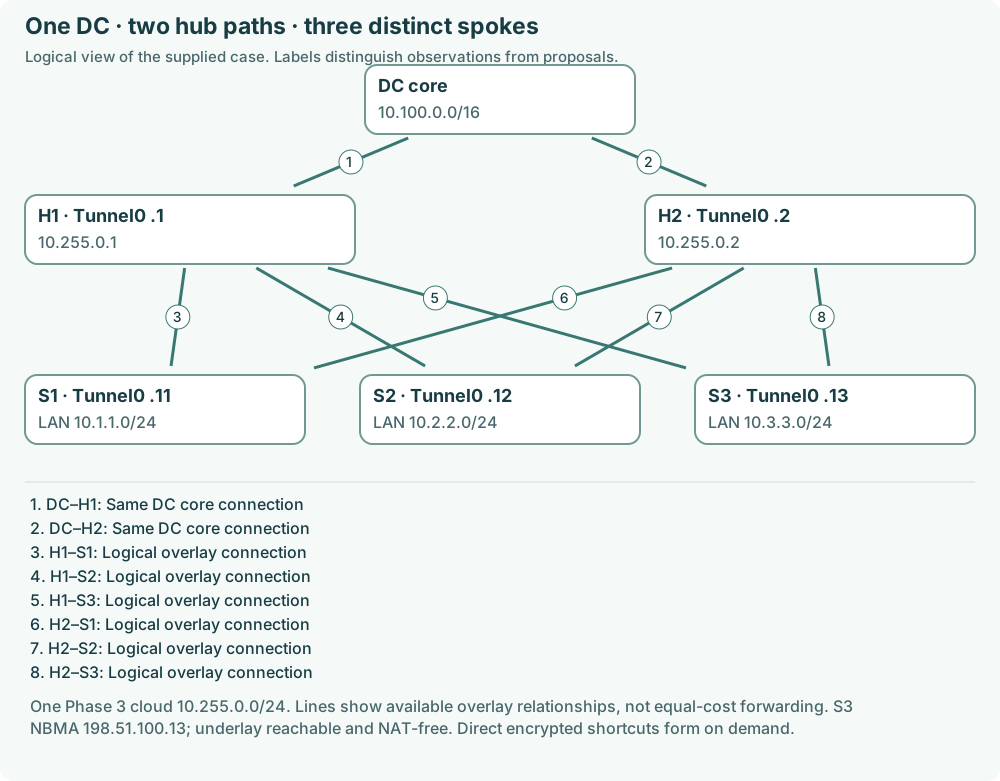 Open full-size topology ↗
One Phase 3 cloud: 10.255.0.0/24. Both hubs share a DC. Lines show logical overlay connectivity; direct spoke shortcuts form on demand.
- Branch LANs
- S1: 10.1.1.0/24 · S2: 10.2.2.0/24 · S3: 10.3.3.0/24
- S3 NBMA
- 198.51.100.13
- Underlay
- Reachable, NAT-free
EXHIBIT B
Read the final clarification.
Operations engineer · initial proposalI suggest keeping H2 shut until we need it and disabling hub next-hop-self for direct branch traffic. Please review those assumptions against the required failure behavior.
Service owner · final requirementKeep both routing adjacencies up. During healthy operation only H1 should carry spoke-to-DC traffic; use H2 after H1 fails and return to H1 when it recovers. H2 must already be a feasible successor at every spoke. Preserve branch metrics and the core return policy. The earlier shutdown proposal does not meet this requirement.
Change manager · authorized scopeLimit the change to a DC-only outbound offset on one hub Tunnel0. Choose one of the tested values: 12,800, 51,200 or 6,400. This exercise protects a hub failure; both hubs share the DC, and full DC disaster recovery is outside this change.
Supplied baseline
mGRE/IPsec; dual NHS registration and unicast/multicast maps; hub dynamic multicast mapping; connected-only stub spokes; active T0 and hub-core interfaces; passive branch LANs.
Classic EIGRP 100, default K values, variance 1. Exact branch prefixes; no overlay summary or default. Hub split horizon and next-hop-self start ON. Core return routing already prefers H1 and fails over to H2.
EXHIBIT C
The numbers that matter.
Measured rule: an H2 outbound DC offset d adds exactly d to both H2 RD and each spoke’s total via H2. H1 is unchanged. No lower historical FD exists.
Synthetic instructional measurements. Judge every spoke, not just S1.